PyLHE demo
The LHE File Format
standardized format to describe events generated in high-energy physics simulations
widely used in the context of Monte Carlo event generators
designed to facilitate the exchange of event information between different software packages
Key Features
XML-Based with Fortran mixin: both human-readable and machine-readable.
Event Structure: contains a series of events, each described by particles and their properties.
Basic Structure
An LHE file typically consists of the following main components:
Header: Contains metadata, version and generator information.
Initialization Block: Describes the initial state of the event, including the incoming beams.
Event Blocks: Each event is described in its own block, detailing the initial, intermediate, and final state particles.
Weights Block: Optional block that provides additional information about the event weights.
<LesHouchesEvents version="1.0">
<header></header>
<init>
beam1id beam2id beam1energy beam2energy pdfg1 pdfg2 pdfs1 pdfs2 idweight nproc
crosssection crosssectionerror crosssectionmaximum pid
...
</init>
<event>
nparticles pid weight scale aqed aqcd
id status mother1 mother2 color1 color2 px py pz E m lifetime spin
...
</event>
...
</LesHouchesEvents>
New since version 1.0.0
Strict typing checks with MyPy
Larger test suite
Sphinx documentation at https://pylhe.readthedocs.io/
IO access via @classmethods LHEFile.fromstring/fromfile
from pylhe import LHEFile

mylhe = """
<LesHouchesEvents version="1.0">
<header></header>
<init>
11 -11 100.0 100.0 0 0 0 0 3 1
3.783590 0.001676 0.001569 0
</init>
<event>
6 0 3.783590e-06 200 0.007849 0.1075
11 -1 0 0 0 0 0 0 100.0 100.0 0 0 9.0
-11 -1 0 0 0 0 0 0 -100.0 100.0 0 0 9.0
22 2 1 2 0 0 0 0 0 200 200 0 9.0
2 1 3 0 0 0 48.253308 67.445271 -54.164510 99.050697 0 0 9.0
21 1 3 0 0 0 -1.190913 -12.743630 5.613176 13.975913 0 0 9.0
-2 1 3 0 0 0 -47.062395 -54.701640 48.551333 86.973389 0 0 9.0
</event>
</LesHouchesEvents>
"""
lhef = LHEFile.fromstring(mylhe)
lhef
LesHouchesEvents(init=LHEInit(initInfo=LHEInitInfo(beamA=11, beamB=-11, energyA=100.0, energyB=100.0, PDFgroupA=0, PDFgroupB=0, PDFsetA=0, PDFsetB=0, weightingStrategy=3, numProcesses=1), procInfo=[LHEProcInfo(xSection=3.78359, error=0.001676, unitWeight=0.001569, procId=0, npLO=None, npNLO=None)], generators=[]), events=<generator object LesHouchesEvents.frombuffer.<locals>._generator at 0x7fc4f27c6140>, header=LHEHeader(initrwgt=LHEInitRWGT(entries=[]), extra_elements=[], extra_attributes={}), comment=None, version='1.0', extra_attributes={})
theevent = next(lhef.events)
theevent
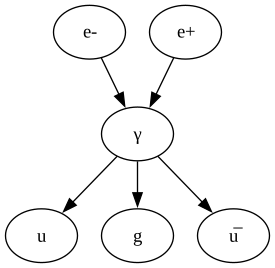
Structured dataclasses instead of deprecated dicts
old dict way
becomes simpler
lhef.init.initInfo.beamA
11
theevent.particles
[LHEParticle(id=11, status=-1, mother1=0, mother2=0, color1=0, color2=0, px=0.0, py=0.0, pz=100.0, e=100.0, m=0.0, lifetime=0.0, spin=9.0),
 LHEParticle(id=-11, status=-1, mother1=0, mother2=0, color1=0, color2=0, px=0.0, py=0.0, pz=-100.0, e=100.0, m=0.0, lifetime=0.0, spin=9.0),
 LHEParticle(id=22, status=2, mother1=1, mother2=2, color1=0, color2=0, px=0.0, py=0.0, pz=0.0, e=200.0, m=200.0, lifetime=0.0, spin=9.0),
 LHEParticle(id=2, status=1, mother1=3, mother2=0, color1=0, color2=0, px=48.253308, py=67.445271, pz=-54.16451, e=99.050697, m=0.0, lifetime=0.0, spin=9.0),
 LHEParticle(id=21, status=1, mother1=3, mother2=0, color1=0, color2=0, px=-1.190913, py=-12.74363, pz=5.613176, e=13.975913, m=0.0, lifetime=0.0, spin=9.0),
 LHEParticle(id=-2, status=1, mother1=3, mother2=0, color1=0, color2=0, px=-47.062395, py=-54.70164, pz=48.551333, e=86.973389, m=0.0, lifetime=0.0, spin=9.0)]
theevent.particles[0].id
11
theevent.mothers(theevent.particles[-1])
[LHEParticle(id=22, status=2, mother1=1, mother2=2, color1=0, color2=0, px=0.0, py=0.0, pz=0.0, e=200.0, m=200.0, lifetime=0.0, spin=9.0)]
print(lhef.tolhe())
<LesHouchesEvents version="1.0">
<header />

<init>
     11    -11  1.0000000e+02  1.0000000e+02     0     0     0     0     3     1
 3.7835900e+00  1.6760000e-03  1.5690000e-03     0
</init>
</LesHouchesEvents>
⚠️ No Events?!: We already consumed the events
yielded by the generator. The generator approach is great for large files or event generation streams, but what if we just want to modify the/some events in a list-like fashion.
lhef = LHEFile.fromstring(mylhe, generator=False)
New output/write to file LHEFile.tofile/tolhe
lhef.tofile("myevents.lhe.gz")
print(lhef.tolhe())
<LesHouchesEvents version="1.0">
<header />

<init>
     11    -11  1.0000000e+02  1.0000000e+02     0     0     0     0     3     1
 3.7835900e+00  1.6760000e-03  1.5690000e-03     0
</init>
<event>
  6      0  3.7835900000e-06  2.0000000000e+02  7.8490000000e-03  1.0750000000e-01
   11  -1   0   0   0   0  0.00000000e+00  0.00000000e+00  1.00000000e+02  1.00000000e+02  0.00000000e+00  0.0000e+00  9.0000e+00
  -11  -1   0   0   0   0  0.00000000e+00  0.00000000e+00 -1.00000000e+02  1.00000000e+02  0.00000000e+00  0.0000e+00  9.0000e+00
   22   2   1   2   0   0  0.00000000e+00  0.00000000e+00  0.00000000e+00  2.00000000e+02  2.00000000e+02  0.0000e+00  9.0000e+00
    2   1   3   0   0   0  4.82533080e+01  6.74452710e+01 -5.41645100e+01  9.90506970e+01  0.00000000e+00  0.0000e+00  9.0000e+00
   21   1   3   0   0   0 -1.19091300e+00 -1.27436300e+01  5.61317600e+00  1.39759130e+01  0.00000000e+00  0.0000e+00  9.0000e+00
   -2   1   3   0   0   0 -4.70623950e+01 -5.47016400e+01  4.85513330e+01  8.69733890e+01  0.00000000e+00  0.0000e+00  9.0000e+00
</event>
</LesHouchesEvents>
!zcat myevents.lhe.gz
<LesHouchesEvents version="1.0">
<header />

<init>
     11    -11  1.0000000e+02  1.0000000e+02     0     0     0     0     3     1
 3.7835900e+00  1.6760000e-03  1.5690000e-03     0
</init>
<event>
  6      0  3.7835900000e-06  2.0000000000e+02  7.8490000000e-03  1.0750000000e-01
   11  -1   0   0   0   0  0.00000000e+00  0.00000000e+00  1.00000000e+02  1.00000000e+02  0.00000000e+00  0.0000e+00  9.0000e+00
  -11  -1   0   0   0   0  0.00000000e+00  0.00000000e+00 -1.00000000e+02  1.00000000e+02  0.00000000e+00  0.0000e+00  9.0000e+00
   22   2   1   2   0   0  0.00000000e+00  0.00000000e+00  0.00000000e+00  2.00000000e+02  2.00000000e+02  0.0000e+00  9.0000e+00
    2   1   3   0   0   0  4.82533080e+01  6.74452710e+01 -5.41645100e+01  9.90506970e+01  0.00000000e+00  0.0000e+00  9.0000e+00
   21   1   3   0   0   0 -1.19091300e+00 -1.27436300e+01  5.61317600e+00  1.39759130e+01  0.00000000e+00  0.0000e+00  9.0000e+00
   -2   1   3   0   0   0 -4.70623950e+01 -5.47016400e+01  4.85513330e+01  8.69733890e+01  0.00000000e+00  0.0000e+00  9.0000e+00
</event>
</LesHouchesEvents>
dict -> dataclass: Parse don’t validate! [1]
Don’t just check if data is valid instead transform it into a well-typed structure.
Make invalid states unrepresentable through type-safe parsing.
[1] https://lexi-lambda.github.io/blog/2019/11/05/parse-don-t-validate/
Dataclasses and strict typing instead of loose dicts
The old layout:
inherits from
dictweird
fieldnamesargsandkwargsugly hypothetical
dicttyping
class LHEInit_old(dict):
    """Store the <init> block as dict."""

    # weightgroup : dict[str, dict[str, dict[str, Union[dict[str, str], str, int]]]]
    fieldnames = ["initInfo", "procInfo", "weightgroup", "LHEVersion"]

    def __init__(self, *args, **kwargs):
        super().__init__(*args, **kwargs)
The new layout below:
members are strictly typed now
properly type hint => better LLM/coding agent integration
autocompletion works better in Jupyter Notebooks and IDEs
data is guaranteed to exist in correct format unlike dicts
MyPy found bugs in the old code while doing this (e.g. missing
Nonechecks)members have documentation strings
data is printed nicely without extra effort
from dataclasses import dataclass

from pylhe import LHEInitInfo, LHEProcInfo


@dataclass
class LHEInit_new:
    """Store the <init> block as a dataclass."""

    initInfo: LHEInitInfo
    """Init information"""
    procInfo: list[LHEProcInfo]
    """Process information"""